
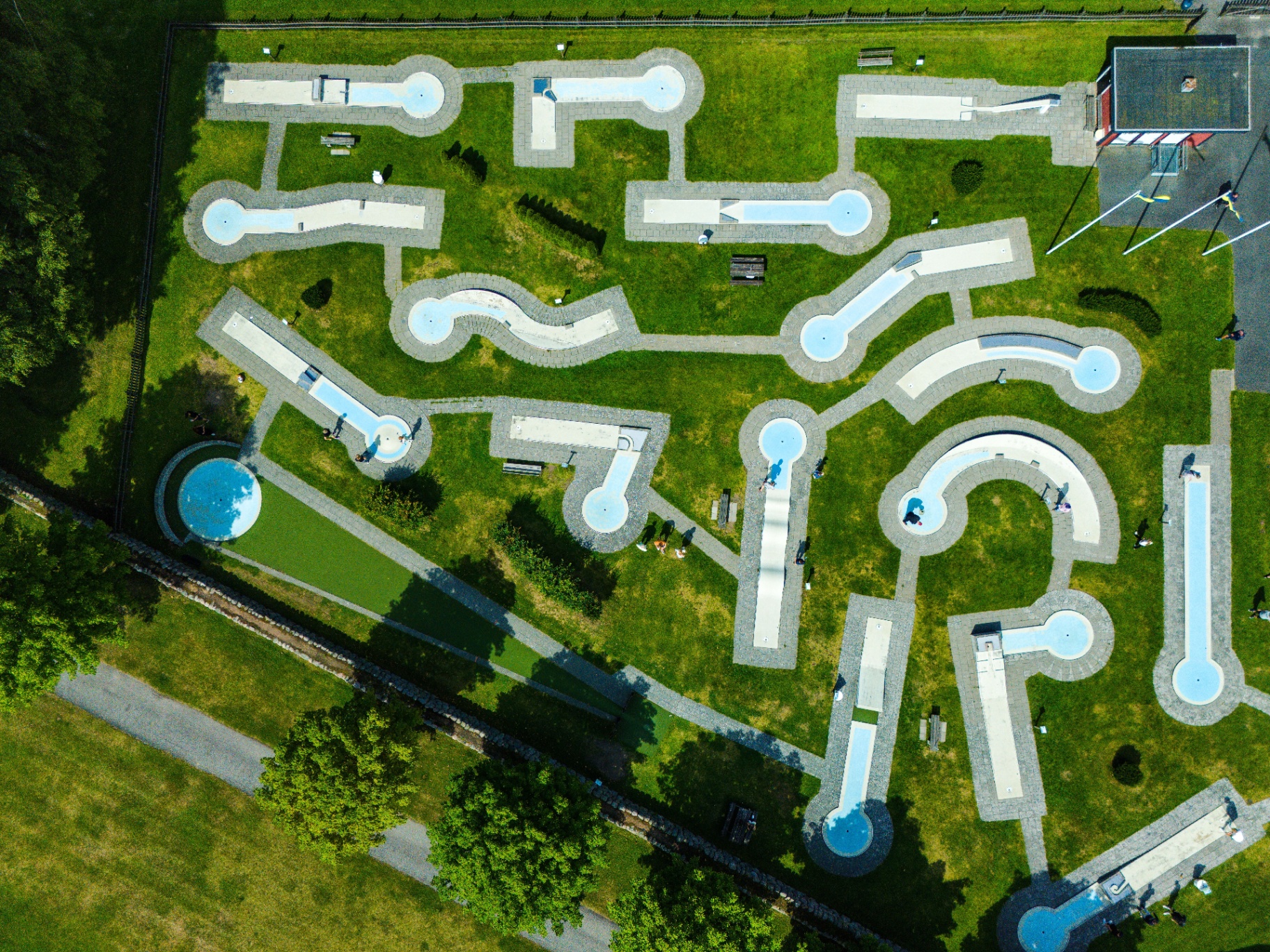
9-Hole vs 18-Hole Mini Golf — which should you build?
Hole count is the biggest single decision in scoping a mini golf project. It drives footprint, build cost, round length, daily guest throughput, and how the course feels as a destination. Here's how to think about the choice.
Side-by-side comparison
| Dimension | 9-hole course | 18-hole course |
|---|---|---|
| Typical footprint (standard) | 2,500–4,500 sq ft | 5,000–9,000 sq ft |
| Typical footprint (themed) | 4,000–6,500 sq ft | 8,000–14,000+ sq ft |
| Build cost (relative) | ≈ 1× | ≈ 1.8–2.2× |
| Round length (per group) | 20–35 min | 45–75 min |
| Daily throughput potential | Higher per sq ft | Higher per visitor |
| Reads as | Amenity / experience | Destination attraction |
Round length & throughput
A 9-hole round in India typically takes a group of three to four players around 20–35 minutes, comfortably fitting inside a restaurant break, an office lunch hour, or a quick resort pre-dinner activity.
An 18-hole round takes 45–75 minutes — long enough that it becomes the planned activity for the visit rather than something done alongside another reason for being on the property.
The round-length difference is more meaningful than it sounds. A 25-minute experience supports impulse play; a 60-minute one requires commitment and changes how the venue books and prices it.
Revenue implications
For paid attractions, an 18-hole course typically supports a noticeably higher per-round price than a 9-hole course — it's read as a fuller experience. But total daily revenue depends on throughput: a 9-hole course at peak hours can cycle more groups through the same hours of the day.
For free-to-play amenities (hotel guests, residents, employees), hole count is mostly about how prominently mini golf shows up in the property's experience. A 9-hole course is an amenity; an 18-hole course is a story the property tells about itself.
Right call by context
- Boutique resort / clubhouse / school / small FEC9-hole. Right-sized for the audience and visit pattern; no need to over-build.
- Large resort, premium property, destination FEC18-hole. Reads as a real attraction worth driving to, not an in-passing amenity.
- Theme park, water park, large entertainment destination18-hole, often as a themed adventure-golf course; smaller layouts get lost on a large property.
- Restaurant, brewery, rooftop bar6–9-hole compact. The course's job is to extend dwell time, not be the full evening.
- Land or budget genuinely constrained9-hole. It's enough to feel like a real course, and a phased extension is feasible later.
Building in phases — 9 now, 18 later
Both 9-hole and 18-hole courses can be designed so the layout has a natural extension path — you build 9 holes now and add 9 more in a later phase once usage and ROI are proven.
The catch: phased builds only work if the master plan reserves the land and the design accounts for the extension from day one. Trying to retrofit an extension onto a course that was designed as a standalone 9-hole installation tends to feel disjointed and is often more expensive than building 18 holes upfront.
Frequently Asked Questions
Q01Is an 18-hole course always better?+
No. For boutique resorts, schools, restaurants and smaller FECs, a well-designed 9-hole course is usually the right call — better ROI, better fit to actual visit length, and easier to operate.
Q02How long does a round take?+
Roughly 20–35 minutes for 9 holes and 45–75 minutes for 18 holes, depending on group size, traffic and difficulty.
Q03Does an 18-hole course cost twice as much as a 9-hole course?+
Roughly 1.8–2.2× as much, depending on theming level and shared infrastructure (entry zone, equipment, lighting) that doesn't quite double.
Q04Can I start with 9 holes and add 9 more later?+
Yes — but only if the master plan reserves the land and the design is drawn for a phased build from day one. Retrofitting an extension onto a standalone 9-hole course is rarely clean.